
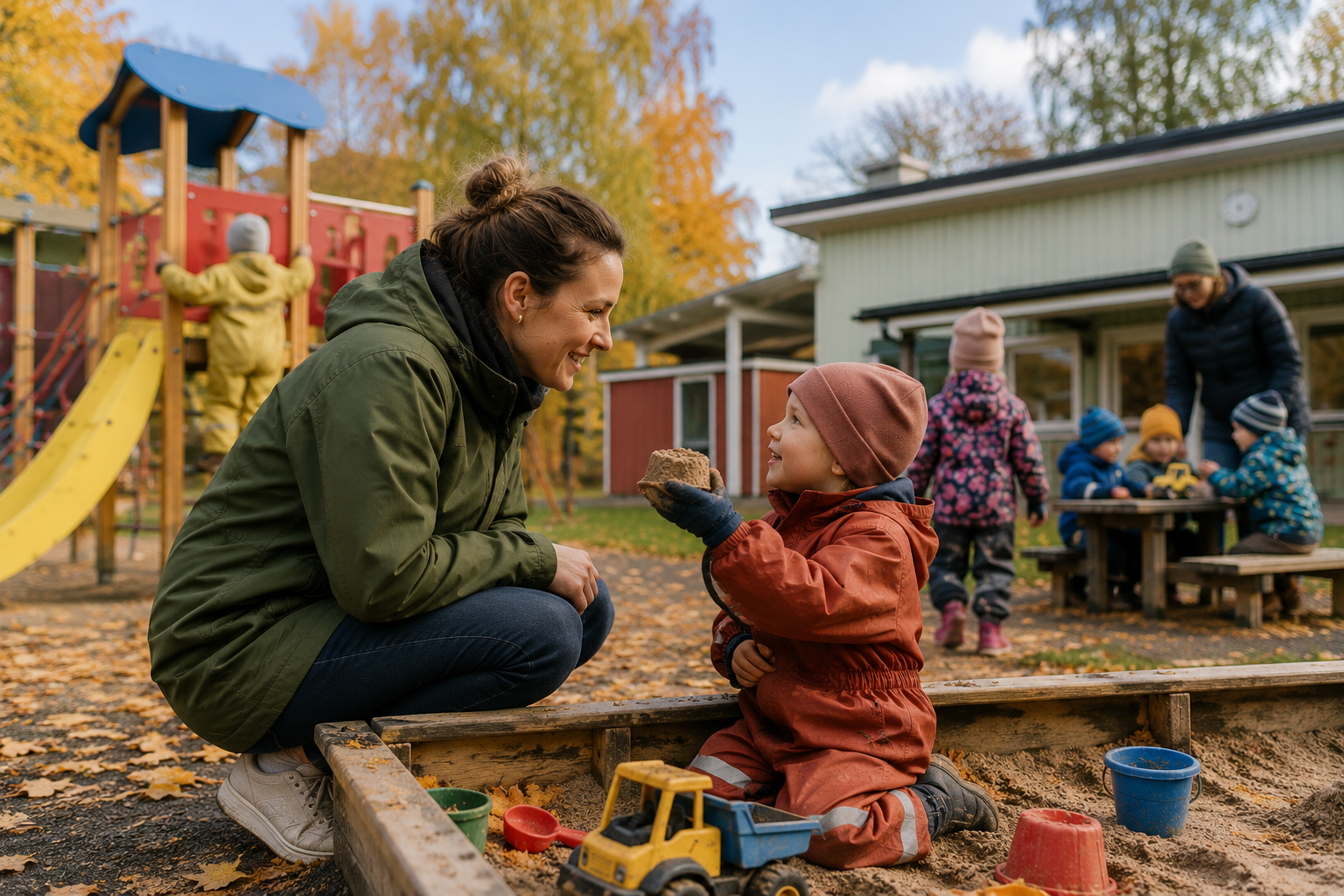
Speech therapy doesn't always take place at a therapist's practice. Depending on the child's situation and rehabilitation goals, a speech therapist may also meet the child in their own everyday environment — for example, at daycare, at school, or at home.
To a parent, the idea might feel a bit unfamiliar at first. What does a therapist do at daycare? Is the child in a separate room during the therapy visit? And what happens during a home visit?
Speech therapy carried out in an everyday environment can look very different for different children. Sometimes work is done one-on-one in a quiet space, and sometimes the skills being practiced are intentionally taken into part of the child's usual situations. What matters is where and how the child's rehabilitation goals can best be promoted.
If you are considering seeking speech therapy more broadly, also read our article How to access speech therapy.
Why is speech therapy carried out in the child's everyday environment?
Communication is needed everywhere. A child needs language and interaction skills, for example, when playing with other children, asking for help, following an adult's instructions, participating in teaching, telling about the day's events, and expressing their own needs. Therefore, supporting the child's skills in the very environments where they need them can be beneficial.
In an everyday environment, a speech therapist can also see how the child's communication works in ordinary situations. This can help in finding support methods that fit exactly into the child's own day.
If you are wondering when you should seek speech therapy for your child, also read our article When does a child need speech therapy?.
What does a speech therapist do at daycare?
At daycare, a speech therapy visit can be carried out in many ways. A speech therapist may, for example, work one-on-one with the child in a quiet space. In therapy, they may play, play games, look at books, or do other activities meaningful to the child while practicing rehabilitation goals.
Sometimes the therapist may also participate in the child's regular daycare day. Such situations can include, for example:
- play
- meals
- dressing
- outdoor activities
- small group activities
- morning circle or other shared activities
In these cases, practice can involve, for example, communication initiatives, understanding speech, using pictures, turn-taking, or acting with other children in a real situation. However, it is not appropriate to practice all goals in a group. Sometimes the child benefits more from quiet one-on-one work. Often these methods can also be combined.
What about speech therapy at school?
At school, speech therapy can be integrated into the child's school day and rehabilitation goals. The therapist can work with the student in a separate space or monitor and support communication, for example, in the classroom, during recess, at lunch, or in other school day situations.
In the school environment, linguistic skills are needed constantly. The child needs, for example, to understand instructions, concepts, and questions, follow a conversation, tell about things, ask for help, and participate in shared activities.
The speech therapist can, together with the school staff, consider what kind of methods facilitate this particular child's participation. These can include, for example, visual support, breaking down instructions, communication pictures, a communication device, or a method suitable for the child to allow more time to answer.
What happens during a home visit?
A home visit does not mean that the home should be prepared for therapy. An ordinary home is enough. In speech therapy, the child's own toys, books, games, and interests can be used. Sometimes, completely ordinary everyday situations can also be utilized in therapy.
The therapist can, for example, look together with the parent at how the child asks for things, makes choices, understands instructions, or participates in shared activities.
The advantage of a home visit can be that the methods to be learned can be tried directly in the environment where the family uses them. However, the parent does not need to organize a program for every therapy session, and the home does not need to be a tidy or quiet therapy room. The speech therapist becomes part of the child's ordinary environment — not to assess the home.
Does the parent have to be present in therapy?
It depends on the child, the goals, and the situation. Sometimes the parent participates in the entire visit. Sometimes the child and the therapist work part of the time one-on-one, and at the end of the visit, thoughts are exchanged with the parent.
Especially for young children, the parent's presence can be useful because the therapist can at the same time show in practice different ways to support the child's communication. The purpose is not to assess the parent's actions. The speech therapist and the parent can together consider small changes that fit the everyday life of that particular family.
Why is cooperation done with daycare and school?
The adults working with the child spend much more time with them than the speech therapist. Therefore, they also have enormous opportunities to support the child's communication in ordinary situations. A speech therapist can, for example:
- discuss the child's communication with the staff
- show how the child's communication methods are used
- plan visual support methods
- help adapt the language used by the adult
- think of ways to support the child's participation
- monitor how the skills practiced in therapy are seen in everyday life
The goal is not to turn daycare or school staff into therapists. The purpose is to find small and practical ways that can be combined with what happens during the day anyway.
Does the child need their own therapy room?
Not necessarily. A quiet space can be very useful when the thing to be practiced requires concentration or environmental stimuli make the child's work difficult. On the other hand, some skills are appropriate to practice right where they are needed. If the goal is, for example, to practice communicating with other children, just working one-on-one with the therapist is not always enough.
Good rehabilitation can therefore include both quiet individual work and practicing skills in natural situations.
What if the child doesn't want to go with the therapist?
Getting to know a new adult sometimes takes time. A speech therapist does not need to get the child to go to a separate room with them or do planned tasks on the first meeting. Initially, for example, you can play in an environment familiar to the child, monitor their actions, and look for shared interests.
Building trust is part of therapy. When the child feels the situation is safe and the therapist is familiar, shared work also usually becomes easier.
Therapy shouldn't stay in the therapy room
In speech therapy, a skill can be practiced successfully with the therapist, but the actual benefit arises only when the child is able to use the skill elsewhere as well. The child does not need to be able to transfer a new skill from one environment to another alone. Adults can help build situations where it is possible for the child to use what they have learned at home, at daycare, at school, and with other people.
Therefore, everyday environments and cooperation with people close to the child are often an important part of children's speech therapy. The goal is ultimately a very practical thing: that the child has the best possible means in their own life to understand others, express themselves, participate, and be understood.
If you want to read more about what speech therapy is like in practice, read our article What happens in speech therapy? or learn about Sensis Terapia's speech therapy for children.

Author
Bettina Paasila
Speech and language therapist
Looking for speech therapy for your child?
Sensis Terapia provides speech therapy for children at the practice as well as in the child's everyday environments, in line with the rehabilitation goals and the granted therapy.